
Politics show
DKZ Microgallery at Democracy Creative at the Soda Plant
September 2024
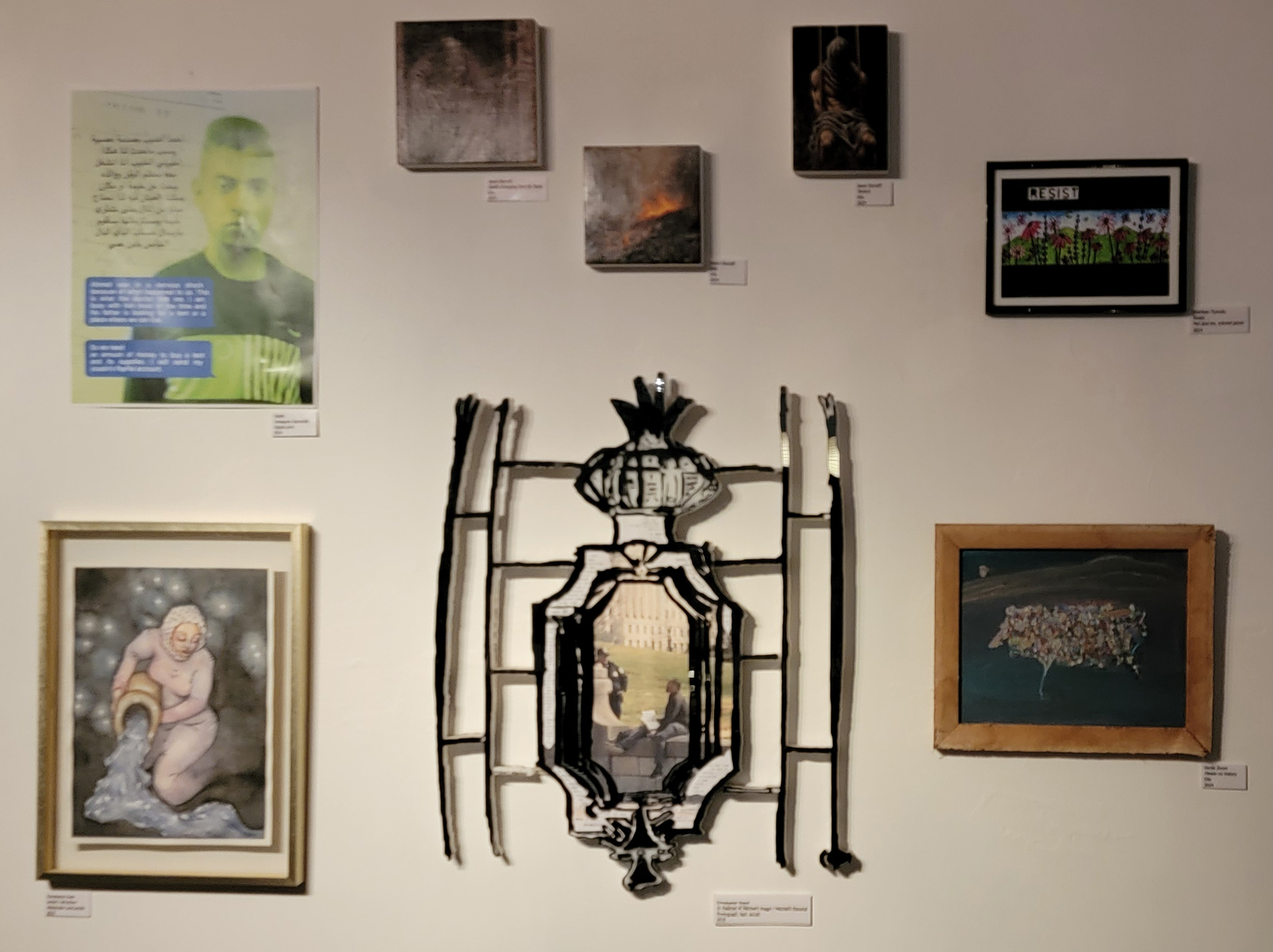
Clockwise from top left:
Gzilith
Instagram Genocide
Digital print
2024
Jason Gorcoff
Death Emerging from its Tomb
Oils
2024
Jason Gorcoff
War
Oils
2024
Jason Gorcoff
Torture
Oils
2024
Kathleen Tumulty
Resist
Pen and ink, colored pencil
2024
Derek Zwyer
Please no history
Oils
2024
Christopher Kojzar
In Defense of Mitchell’s Image / Mitchell’s Drawing
Photograph, text, acrylic
2018
Constance Craik
social / structure
Watercolor and acrylic
2023
Politics: an art show
Curated by Derek Kahn Zwyer
September 6, 2024
In one essay in Art in the After-Culture (2022), art writer Ben Davis draws a connection between the rise of the environmentalism movement in the 1960’s and the development from Abstract Expressionism to Pop Art, Minimalism, and Conceptualism. In response to growing self-awareness of harmful consequences of post-war post-industrialization consumption culture, artists responded by discovering new relationships between form and function in their work.
In the last half century, profound leaps in technological capacity have only continued to feed the popular consciousness of catastrophic malice and negligence towards not just the environment, but also towards human beings and communities. If our political world feels more divided than ever, it’s not due to a lack of information related to harms inflicted, but instead is moreso due to a surplus of information, and a surplus of disjointed and inconsistent forms this information can take.
As contemporary art movements have been explored and developed, artists have simultaneously been increasingly struggling to cope with the failures of responsibility taking place all around them, and works of art demonstrate the full spectrum of hope and despair. Artists ask themselves what the purpose of their creative expression is when so many people lack water, food, medicine, and the safety to live a life free from constant trauma.
In the 2020s we are less than ever able to lie to ourselves about the state of the world. This splits the population generally into those suffering with increasingly painful truths, and those suffering with increasingly disconnected falsities. This fragmentation has its corollary in the fragmentation of artistic production, as the steady increase in neoliberal policies and financial speculation enables markets to increasingly dominate personal tastes. Today, with so many of the possibilities of 2D, 3D, and 4D art being somewhat covered ground, and with the increasing struggle against individualized alienation, groups of artists may be more likely to center around common sociopolitical causes rather than stylistic or aesthetic commonalities.
The pieces in this show are a small sample of artistic expressions of political consciousness, by artists in their 20s, 30s, and 40s, all based in Vermont. They work as teachers, service workers, social workers, or in the city government, and would all certainly have preferred to push a button and resolve social and political inequality rather than to make art, if this false dichotomy represented an actual choice. This tension between felt inefficacy in the political realm and felt efficacy in the creative realm is part of the generating principle of political art, as motivations that can’t find outlet in a destructive polity find outlet in a creative reality, where the artist can serve both as populus and legislator, as executive and employee.
We can create the world again, probably.
Artists’ statements on works
Constance Craik
The water-bearer, the life-bringer, for which the social structure gathers round: Aquarius. This winter, I attended a protest where it seemed every powerful speech revolved around the importance of voice, of distant family, of far-reaching human connection, of community justice, of deep consideration for the place we occupy in our society, of aid, of rebellion, of finding literal clean drinking water. Aquarian themes. Through Aquarius, Saturn expresses his social side–the need for reliance on one another to create something that stands the test of time. Resilience in the face of his own authority. The power in numbers. In groups and Out groups. Saturn is not a balm to the suffering, but there is the chance that suffering is not in vain. This piece took me three long winter months, and now as the summer comes to a close the destruction still continues. I utilized this page as a place for prayer and to hope for systems that exalt humanity.
Derek Zwyer
This painting was done on a frame recycled from a heap of possessions outside an apartment building in Brooklyn and brought back to Vermont by train. The technique that makes up the central figure is one that I call dabbling, in that it’s done without much reference to a larger shape or form that it’s contributing to. Each bit of paint is applied, removed, or layered over for its own sake, to create an unintended collective effect from the generally self-interested constituent parts. When a unified image starts to form, it’s accentuated and emphasized. In yet another election year in the US with two imperialist political parties battling for the reins of the monopoly on violence, this painting may bring the mind to the innumerable interacting individuals ignored below the surface of apparent representations.
Christopher Kojzar
At the time, I had been sketching a man lounging on a bench for less than a minute before the officer came to my side. I was an easier target than another male colleague of mine who had been drawing at a distance. The black acrylic frame is his drawing. He also took the photograph. It is a fool’s errand for me to try to understand exactly and thoroughly why Officer Weatherbee approached me, even though I am inclined to link it to the anti-terrorist guidelines of the ‘see something, say something’ campaign that lists ‘sketching in public’ as suspicious activity. During the fifteen-minute conversation I had with Officer Weatherbee, no one ever approached my white colleague to question why he drew. I asked the guard, “Do I look like a threat?” He shook his head and stated that he just wanted to see what I was drawing. But as a black male, I consider, daily, how extensively all people’s implicit racial biases affect their/our behaviors, so I didn’t find the question to be presumptuous.
Gzilith
gofundme.com/support-ahmeds-fight-for-a-better-life
Ahmed is a 21 year old Palestinian whose mother, Sana, reached out to me on instagram after seeing me share other Palestinian stories. She needed help starting a GoFundMe campaign to feed and house her family in Gaza and wanted it to focus on her son Ahmed, who had become deeply depressed. She wanted to give him hope. They still need help now more than ever. To read their story and donate, visit the GoFundMe link above. This piece of art is a digital collage including messages, a document, and a photo of Ahmed.
Kathleen Tumulty
I made these pieces inspired by Bread and Puppet and certain art styles I’ve seen on herbal products from Vermont. All the flowers are growing together in my drawings and to me it represents people growing together and supporting each other. I draw about resistance as living close with the earth, tending to the land, caring for each other, and growing together.
Jason Gorcoff
These three small paintings are my stylized response to the suffering that war inflicts on the peoples of the world: displacement, death and dehumanizing torture.
Back to CV page


 Derek Zwyer